
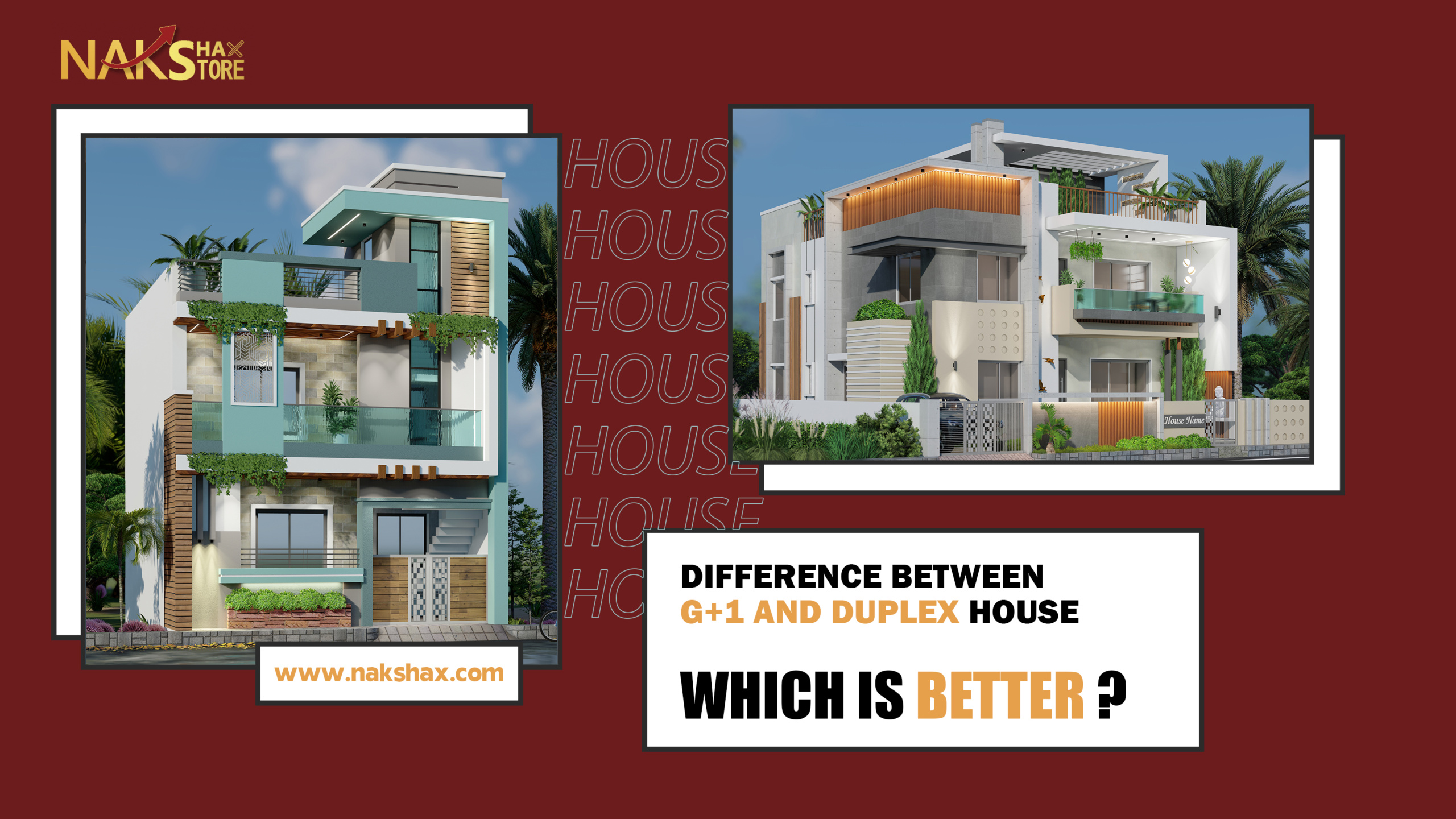
🏠 G+1 vs Duplex House – Which One Should You Choose for Your Dream Home?
Choosing a house design is one of the most exciting yet confusing parts of building your dream home. The layout you select will significantly influence your lifestyle, future family dynamics, maintenance requirements, and even your financial decisions. Among the many options available, two popular choices often spark a debate — G+1 vs Duplex House.
At first glance, G+1 and Duplex houses might seem quite similar. However, their purpose, functionality, and architectural design are quite different. So, how do you decide which one aligns better with your family’s needs, personal preferences, and overall budget?
In this detailed blog on G+1 vs Duplex House, we’ll break down everything — from basic definitions and structural differences to their benefits, limitations, and real-life use cases. And don’t worry, this post goes beyond just technical terms. It’s crafted to help you make a confident and informed decision for your home-building journey. 🏡✨

Before comparing, let’s first understand what each home layout really means.
🔍 What is a G+1 House?
A G+1 house stands for Ground plus One floor construction. In simple words, this type of house has two stories — the ground floor and the first floor — but they can function independently or together depending on how you design them.
✅ Characteristics of a G+1 House:
Two separate floors, often with separate access points.
Ideal for joint families or families with multiple generations.
Can be used as independent residential units.
Has the potential to generate rental income.
Usually, each floor has its own kitchen, bathrooms, and entryway.
🧾 Practical Example:
Consider Mr. Raj, a retired school teacher, who lives on the ground floor while his son and daughter-in-law live on the first floor. They maintain privacy and still live under the same roof. When the son goes abroad, the first floor is rented out, providing extra income.
🔍 What is a Duplex House?
A Duplex house is a single residential unit built over two floors but occupied by a single family. The floors are usually interconnected by an internal staircase, allowing free movement within the home.
✅ Characteristics of a Duplex:
One family occupies both floors.
Internal staircase is a must-have.
Bedrooms are usually on the upper floor, while the lower floor has common areas like the kitchen, living room, and dining space.
Offers a luxurious and elegant design layout.
🧾 Practical Example:
Mrs. & Mr. Sharma designed a modern duplex for their family. Their kids have their own bedrooms upstairs, while the family spends evenings downstairs in a spacious living room with open dining and kitchen areas — all connected beautifully.
.
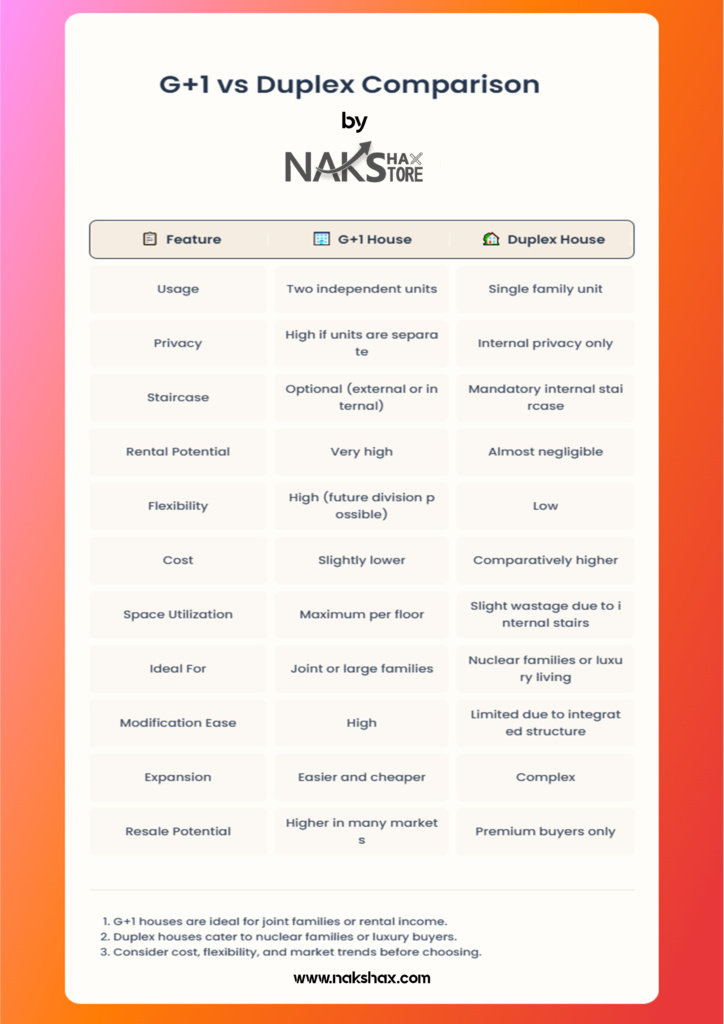
📊 G+1 vs Duplex: Comprehensive Comparison Table
💸 Cost Considerations: Which One is More Budget-Friendly?
Although construction costs per square foot may seem similar at first, several factors can influence the overall budget.
📉 G+1 Home:
Easier structural design
Less cost on internal decor
Modular development possible
Easy to plan construction in stages
Economically suitable for people who want to build one floor and expand later
📈 Duplex Home:
Higher design complexity
Cost of premium interiors
Double-height areas and open designs add cost
More civil work due to internal staircases and extended slabs
💡 Real-World Cost Comparison:
G+1 house: ₹1500–₹1700/sq ft
Duplex house: ₹1700–₹2000/sq ft
But cost isn’t just about construction. Think long-term: rental income, resale value, and maintenance all affect your investment.
Also, duplex homes often involve extra costs like:
False ceilings in double-height areas
Glass partitions
Designer staircases
False roofing and lighting treatments
Hence, the initial cost of a duplex might look 20% higher compared to a basic G+1 plan.

Explore your budget effortlessly with our easy-to-use Budget Calculator.
🔧 Maintenance and Modifications: Flexibility Matters
One of the key advantages of G+1 homes is ease of modification. Floors can be redesigned, renovated, or even rented out later.
In contrast, duplex homes are often harder to reconfigure. Since spaces are interconnected, altering one area can affect the whole layout.
🛠 Example:
A G+1 owner can convert the first floor into a mini office space or studio rental. But in a duplex, such changes may compromise the overall design. For example, you cannot simply lock one floor and rent it without affecting access.
Additionally, maintenance becomes slightly easier in G+1 homes because each floor’s plumbing and electrical layout are separate. In duplexes, plumbing pipelines often run between floors, making repairs more complicated.
🧬 Family Dynamics and Lifestyle Suitability
Your home design must reflect how your family functions.
👨👩👧👦 G+1 Homes Suit:
Large joint families
Families with elderly parents
Multiple tenants or relatives living together
Families who wish to expand in future
👨👩👧 Duplex Homes Suit:
Modern nuclear families
Families with kids wanting private space
Design enthusiasts who value flow and openness
Professionals working from home with separate upper floors
Moreover, for those with differently-abled family members or elderly people who cannot climb stairs, a G+1 offers more options. The ground floor can be customized for accessibility.
📐 Plot Size and Layout Considerations
The size and shape of your plot can also impact your decision.
Small plots (under 800 sq ft) may feel congested in a duplex design due to staircases.
G+1 plans allow better floor-wise utilization of space.
Wider plots benefit duplexes for creating aesthetic staircases, open halls, and lounge areas.
In rectangular or narrow plots, G+1 is more space-efficient.
🧭 Vaastu Compliance and Cultural Beliefs
In many Indian families, Vaastu Shastra plays a key role in house planning.
G+1 allows easier Vaastu adjustments per floor.
Separate kitchens, pooja rooms, and toilets can be better aligned with directional energies.
Duplex homes require advanced planning to maintain Vaastu balance across both levels.
Families with strong spiritual preferences usually find G+1 more adaptable
🔌 Smart Home Integration and Tech Use
Modern homes are integrating IoT and automation — but how does layout affect tech implementation?
In duplex homes, central control systems for lighting, HVAC, and security work seamlessly across both floors.
In G+1 houses, separate floors may need additional controllers or setups.
Hence, duplex homes offer better flow for full-home automation.
🙋 Client Testimonials & Real-Life Experiences
✅ “We opted for a G+1 so we could rent one floor and reduce our EMIs. It worked perfectly!” – Priya S., Pune
✅ “Our duplex feels cozy and luxurious at the same time. The kids love their upstairs space.” – Arjun B., Bangalore
✅ “I built a G+1. When my son got married, we just handed over the top floor — no need to shift houses!” – Mr. Naresh, Ranchi

❓ Frequently Asked Questions
Q1️⃣: Is it possible to convert a duplex into a G+1 later?
Not easily. It may require structural changes, permissions, and new access points.
Q2️⃣: Which one is better for elderly people?
G+1 is better as the ground floor can be used independently.
Q3️⃣: Which design has better resale demand?
G+1 often sells faster, while duplex sells at a premium.
Q4️⃣: Is Vaastu easier in G+1 homes?
Yes. It offers more flexibility.
Q5️⃣: Can I build G+1 now and convert it into a duplex later?
Yes, with internal stairs it can function as a duplex
✅ Final Verdict: Which One Should You Choose?
There’s no one-size-fits-all answer.
Choose G+1 if:
You want rental income.
You have elderly or joint family members.
You may sell or modify in the future.
Choose Duplex if:
You prefer premium aesthetics and open layouts.
You’re building your forever home.
You’re tech-savvy and want a smart home.
In the end, a home is not just walls and ceilings — it’s about how it makes you feel. ❤️
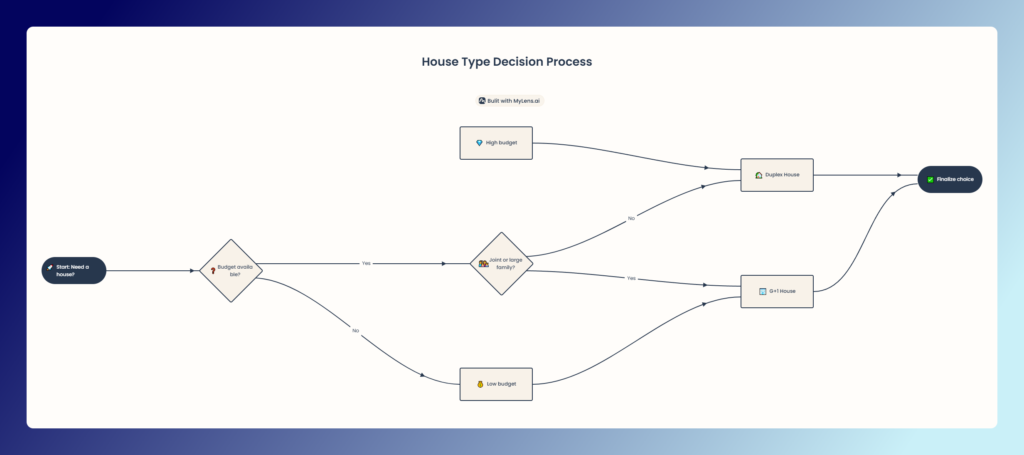
If you’re still confused or need expert guidance, don’t worry—we’re just a call away. Whether it’s a custom floor plan, 3D elevation, or smart Vaastu-based design, Nakshax Store is here to help you at every step of your home-building journey.
📞 Need a Personalized Home Plan?
👉 Contact us via WhatsApp at 7759958487 / 9771128487
📩 Visit: www.nakshax.com
📸 Follow us on Instagram: @nakshaxstore
✨ Sirf Makan nahi, Banaayi Apni Pehchaan!
Thanks for reading. 😊
We hope this blog helped you understand your choices better.
Don’t forget to share this post with your friends and family who are planning to build their dream home too!